
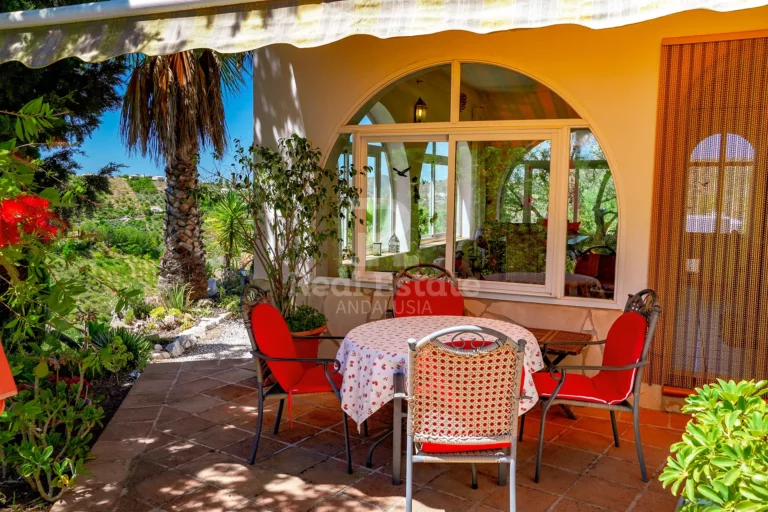

My client owned the land, but the house had no building paperwork
I had a client who wanted to sell a villa he had built on rustic agricultural land near Cómpeta.
The land was legally owned and registered in his name. However, he had built the villa without a building licence or the required permissions, and the house had been fully completed more than six years earlier.
He had the documents for the land, but not the building paperwork needed to clarify the house’s position.
His question was straightforward: how could he “legalise” the house so he could sell it?
The property lawyer’s work involved separating three issues: ownership of the land, the planning status of the house and how the building was recorded. Below, I explain the process without reproducing the client’s private documents or treating his circumstances as a rule for every rural property.
What “legalising the house” actually means
“Legalising” was the word my client used. However, legalisation, AFO recognition and registration are different things.
Actual legalisation involves obtaining the necessary approvals where the building and its use meet the applicable planning requirements.
AFO, short for Asimilado a Fuera de Ordenación, recognises an irregular building’s planning situation where the relevant enforcement period has expired and the other requirements are met. It does not legalise the original construction.
Recording a house in the Land Registry is another separate step. Registration alone does not establish that it was lawfully built.
For that reason, I would not describe a property as “fully legal” simply because an AFO application has been submitted or the house appears in a deed.
Why the house being more than six years old mattered
The villa’s age was relevant, but it was not enough on its own.
Andalusian legislation generally provides a six-year period for certain planning enforcement measures. For building works, the period runs from complete termination or, if later, the appearance of external signs allowing the works to be identified. There are exceptions.
The lawyer therefore needed to establish whether the applicable period had actually expired and whether the property could qualify for AFO.
This is the point I would emphasise to any owner in a similar position: “I built it more than six years ago” is the starting information for an assessment, not a legal conclusion.
The original house and any later additions also need to be considered separately. An older villa does not automatically settle the position of a newer extension, pool or outbuilding.
How the lawyer approached the missing paperwork
The lawyer coordinated the legal side, with technical documentation requiring an architect or another appropriately qualified professional. The town hall, notary and Land Registry each had their own role.
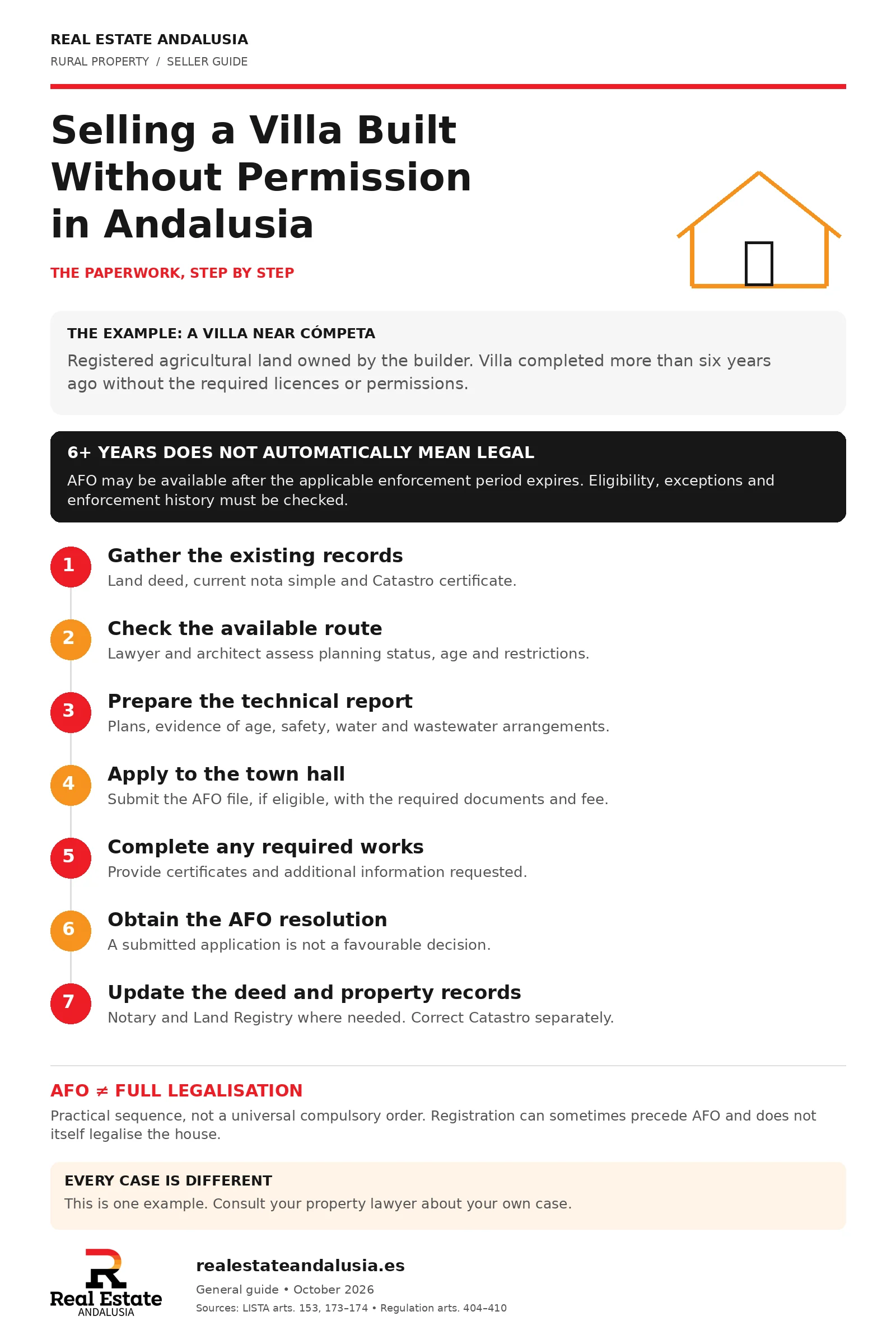
For an AFO route, the practical sequence is as follows. The exact order can change depending on what is already documented.
1. Establish what the existing documents cover
The starting documents are the land’s escritura, a current nota simple and the certificación catastral descriptiva y gráfica.
The purpose is to compare the registered and cadastral information with the property that physically exists.
In my client’s case, having the land registered in his name provided the starting point. It did not resolve the missing documentation for the villa.
2. Check which procedure is available
Before treating the matter as an administrative exercise, the lawyer needs to assess the property’s planning position alongside the technical professional.
That includes the precise land classification, construction history, relevant restrictions and any enforcement or court proceedings.
Calling a plot “agricultural land” does not answer all those questions. The rules affecting the particular plot must be checked.
3. Prepare the technical documentation
For AFO, the technical report identifies the property and describes the building, its measurements, use and completion date. It also addresses risks and the required safety and sanitation conditions.
Plans and evidence of age form part of the documentation. Water supply and wastewater arrangements must also be examined.
The owner’s account of when he built the house is useful background, but the application needs evidence.
4. Submit the application to the relevant town hall
Once the file is prepared, the owner or an authorised representative submits the AFO application with the supporting documents and applicable fee.
The correct municipality is determined by the plot’s location. A property described as “near Cómpeta” may fall within a neighbouring municipality.
At this stage, an application has been made. That is different from recognition having been granted.
5. Address any required works or additional information
The town hall may require corrective works before issuing its decision. Wastewater disposal is one example of an issue that may need attention.
Where works are required, their completion must be evidenced. The procedure can be suspended while they are carried out.
This is why I would avoid promising an owner that the process involves paperwork only.
6. Obtain the formal municipal decision
For the AFO route, the key document is the town hall’s resolución de reconocimiento de AFO.
An architect’s report, proof of submission and a favourable municipal resolution are three different stages. When preparing a property for sale, the description of its status needs to reflect the stage actually reached.
7. Arrange the deed and registration where necessary
If the building is missing from the registered description, the lawyer and notary establish the documentation required to record it.
This may involve an escritura de declaración de obra nueva antigua, followed by submission to the Land Registry. Despite the name, this can concern an old house being formally declared.
Registration has its own requirements and can sometimes happen before AFO. It is not a substitute for resolving the planning position. Any necessary Catastro corrections should also be coordinated.
How long can this take?
I would not use one client’s circumstances to promise another owner a completion date.
The official maximum decision period for an AFO application is six months, subject to applicable suspensions. That does not include all the preparation beforehand or the notarial and registration work afterwards.
If the applicable period expires without an express decision, administrative silence does not mean approval.
The overall timetable depends on the documents available, the technical assessment, any required works and the authorities involved. A case-specific estimate is more useful than a general promise that everything will be finished within a few months.
What this means when you want to sell
For me, the practical lesson from this case is to involve the property lawyer early.
An owner may see one problem: “the house has no papers”. Preparing it for sale means establishing exactly what is missing, which procedure is available and what can accurately be said to a buyer.
Before agreeing a completion deadline, the parties should understand:
- Which documents already exist.
- Which applications or approvals remain outstanding.
- Whether works are required.
- Who will pay for and complete the remaining steps.
- How the contract will deal with delays or an unsuccessful application.
My role as the estate agent is to keep the sale information clear and coordinate communication. The lawyer assesses the legal position, the technical professional assesses the building, and the relevant authorities make their decisions.
Every case is different. This is just one example involving a client who built a villa on agricultural land near Cómpeta and later wanted to sell it. For your own case, you must consult your lawyer, with an architect’s assessment where required, to establish the correct procedure for your property.


